The Smart Display, The Visual Voice Assistant

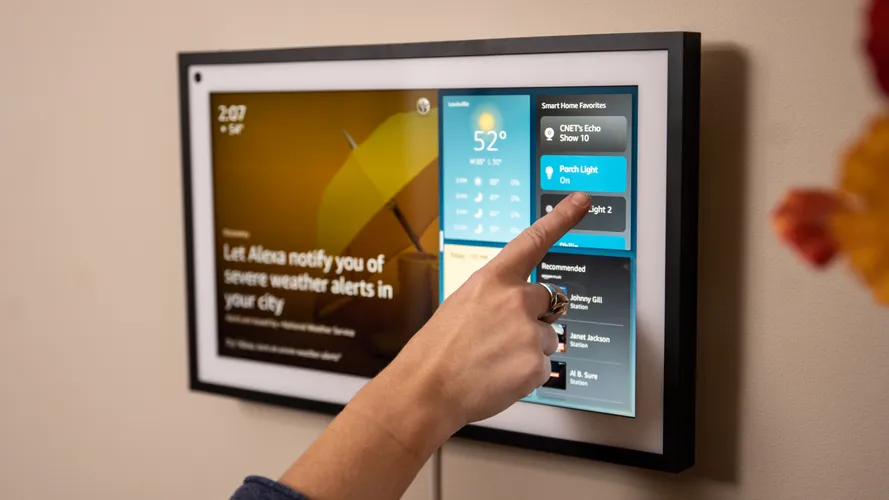
The smart display represents the evolution of the voice assistant from a disembodied voice to a visual interface. Building on the foundation of smart speakers like Amazon Echo and Google Home, smart displays add screens that transform what these devices can do. Video calls, visual recipes, photo slideshows, security camera feeds, and YouTube become accessible through voice commands, creating a new category of ambient home technology.

The leading platforms are Amazon’s Echo Show lineup and Google’s Nest Hub family, with Facebook’s Portal and Lenovo’s Smart Display also competing. Each integrates deeply with its parent company’s ecosystem, offering different strengths. Amazon emphasizes shopping, video calling, and Alexa skills. Google focuses on Assistant integration, YouTube, and Google Photos. The competition drives rapid innovation.

The Smart Display: The Visual Voice Assistant
The Smart Display

Video calling is transformative. A smart display on the kitchen counter means grandparents can video call grandchildren hands-free while cooking. The camera automatically frames subjects, follows movement, and uses wide-angle lenses to capture group calls. For families separated by distance, this casual, always-available connection is genuinely valuable.

Visual recipes guide cooking step-by-step. Ask for a recipe, and the display shows ingredients, instructions, and cooking videos. Voice control means never touching the screen with messy hands. Timers can be set for multiple dishes simultaneously. The kitchen becomes smarter without becoming more complicated.

Photo slideshows turn the device into digital picture frames when not actively used. Google Photos integration surfaces memories automatically. Amazon Photos does the same for Prime members. The display cycles through personal images, making the device feel personal and warm rather than like cold technology.

Smart home control becomes visual. See which lights are on, adjust thermostat temperature precisely, view security camera feeds, or check who’s at the door. Voice remains primary, but visual confirmation adds confidence and control. The smart display becomes the home’s command center.

Entertainment expands beyond audio. Watch news briefings, YouTube tutorials, or streaming service previews. Follow along with workout videos. View lyrics while music plays. The screen adds dimension to what were previously audio-only experiences.

Privacy features acknowledge the sensitivity of cameras in the home. Physical camera shutters, mute buttons, and indicators when the camera is active provide reassurance. Voice recording history can be reviewed and deleted. These controls are essential for consumer trust.

Ambient computing is the philosophy behind smart displays. The device is not something you actively use but something that’s present, ready to help when needed. It shows the time, weather, and calendar by default. It whispers reminders. It displays photos. It waits, unobtrusively, for your request.

Ecosystem integration determines utility. Amazon’s displays work best with Amazon services, Ring cameras, and Alexa-compatible devices. Google’s displays excel with Google services, Nest cameras, and Assistant integration. Choosing a platform means choosing an ecosystem, and switching costs are high.

Kids’ editions add durability and child-friendly content. Parental controls limit access and screen time. Educational skills and content make the device a learning tool. For families, specialized versions address concerns about children and screens.

The form factor varies widely. Some displays are designed for countertops, with small screens and compact footprints. Others are larger, meant for walls or tabletops as dedicated hubs. The common thread is placement in high-traffic areas where quick information and control are valuable.

The future includes deeper integration with more services, better camera and display technology, and more natural conversation. Multi-device experiences will allow seamless handoff between displays throughout the home. Artificial intelligence will make assistance more proactive and personalized.

The smart display succeeds because it fits naturally into domestic life. It doesn’t demand attention but offers help when needed. It connects families visually. It controls the increasingly smart home. It displays memories. It is technology that enhances home rather than competing with it, and that may be its greatest achievement.

Cybersecurity in an Age of Digital Vulnerability

Every day, billions of cyberattacks probe the digital infrastructure upon which modern civilization depends. Banks, hospitals, power grids, government agencies, and personal devices are under constant siege from hackers, criminals, state actors, and vandals. Cybersecurity has evolved from a technical specialty into a fundamental requirement for functioning in the twenty-first century. Understanding the threat landscape is the first step toward navigating it safely.

Cybersecurity in an Age of Digital Vulnerability

cybersecurity

The nature of threats has diversified enormously. Nation-state actors conduct espionage and prepare offensive capabilities for potential conflict. Their targets include military secrets, intellectual property, and critical infrastructure. Cybercriminal enterprises operate like businesses, complete with customer support, service-level agreements, and affiliate programs. Ransomware gangs encrypt hospital data and demand payment in cryptocurrency, sometimes paralyzing healthcare delivery. Hacktivists target organizations they oppose politically, defacing websites or leaking documents. Insider threats, whether malicious or accidental, exploit legitimate access.

Ransomware has emerged as particularly devastating. Attackers infiltrate networks, encrypt critical data, and demand payment for decryption keys. When the city of Atlanta was hit in 2018, many municipal services ground to a halt for days. The Colonial Pipeline attack in 2021 caused fuel shortages across the U.S. East Coast. Hospitals have been forced to divert ambulances and cancel surgeries. The business model works because downtime is so costly that paying the ransom often seems cheaper than the alternative.

Supply chain attacks represent an even more insidious vector. Rather than targeting a primary victim directly, attackers compromise a trusted vendor or software provider and use that access to reach multiple downstream targets. The SolarWinds attack, discovered in 2020, inserted malicious code into software updates distributed to thousands of organizations, including multiple U.S. government agencies. A single compromise multiplied into a sprawling intelligence-gathering operation.

The Internet of Things dramatically expands the attack surface. Every connected device, from security cameras to smart thermostats to medical implants, is a potential entry point. Many are manufactured with minimal security, using default passwords that users never change. The Mirai botnet demonstrated the danger, hijacking hundreds of thousands of insecure devices to launch massive distributed denial-of-service attacks that disrupted major internet platforms.

Phishing remains the most common entry vector, exploiting human psychology rather than technical vulnerabilities. Deceptive emails trick users into revealing credentials or installing malware. The most sophisticated attacks use spear-phishing, researching targets to craft convincing, personalized messages. Training users to recognize and resist phishing is essential but never sufficient; eventually someone will click.

The defense landscape is equally complex. Traditional perimeter security, the “castle and moat” approach, is obsolete when the perimeter is everywhere. Zero trust architecture assumes no user or device is trusted by default, requiring continuous verification. Multi-factor authentication provides essential protection against credential theft. End-to-end encryption secures communications. Regular patching closes known vulnerabilities. Backups enable recovery from ransomware without paying.

Nation-states are increasingly involved in both offense and defense. The United States Cyber Command conducts offensive operations against adversaries. China’s cyber capabilities are integrated with its military strategy. Russia has used cyber operations as a component of hybrid warfare against Ukraine and others. International norms are embryonic; attribution is difficult; escalation risks are poorly understood.

For individuals, cybersecurity requires vigilance. Use strong, unique passwords for every account, managed by a password manager. Enable multi-factor authentication wherever available. Keep software updated. Be skeptical of unexpected messages, even from known contacts. Back up important data. Recognize that perfect security is impossible; the goal is to make yourself a harder target than the next person.

Cybersecurity is ultimately a collective challenge. Our networks are only as secure as their weakest node. As digital vulnerability deepens, the imperative for robust, accessible security grows. The alternative is a world where trust erodes, infrastructure falters, and the benefits of connectivity are outweighed by its risks.