Light is more than what eyes see. The electromagnetic spectrum encompasses all forms of electromagnetic radiation, from radio waves longer than buildings to gamma rays smaller than atomic nuclei. Understanding this spectrum reveals invisible universe and enables technologies from microwave ovens to medical imaging.
The Electromagnetic Spectrum
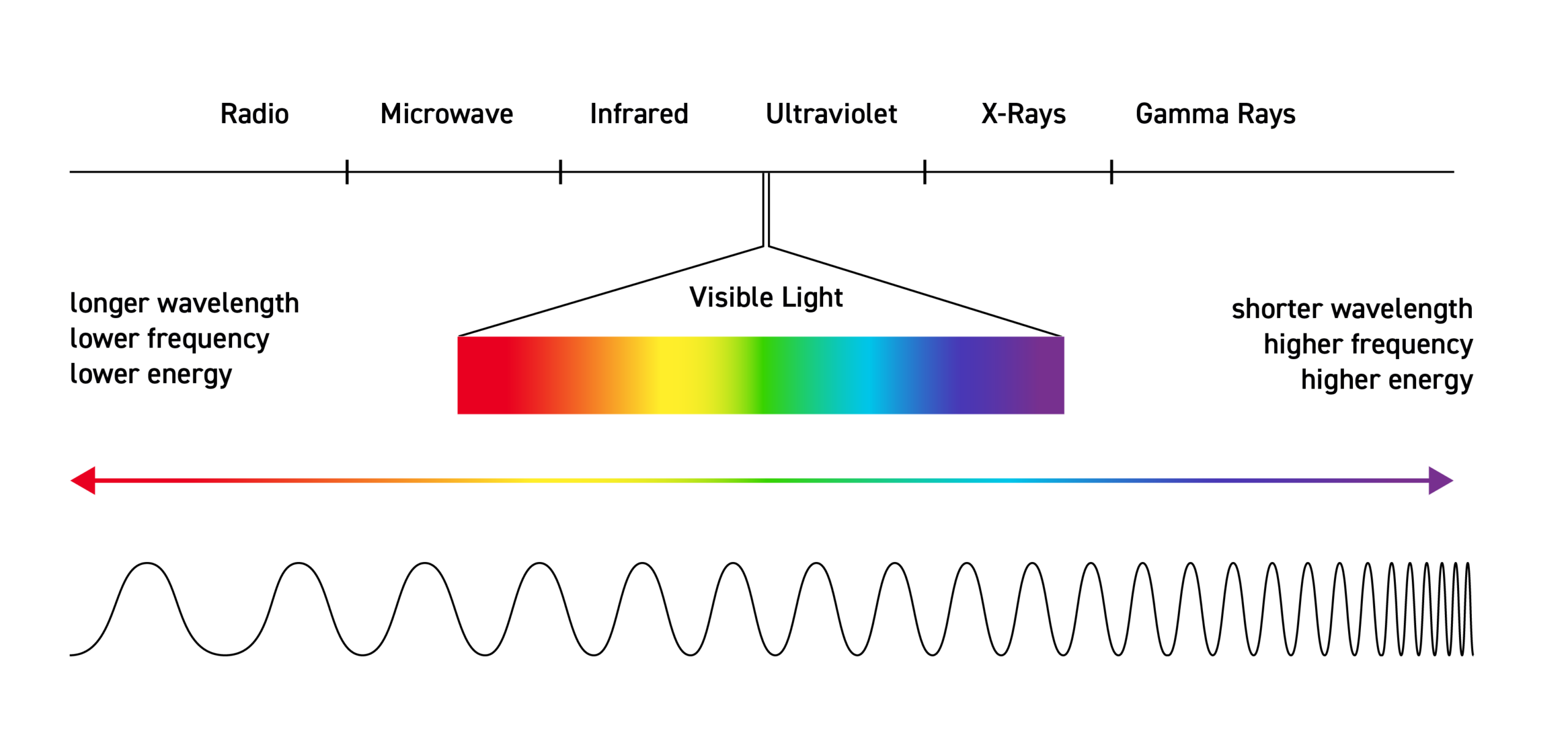
Electromagnetic radiation consists of oscillating electric and magnetic fields traveling at light speed. It requires no medium, traveling through vacuum of space. All electromagnetic radiation shares same nature, differing only in wavelength and frequency. Shorter wavelength means higher frequency and more energy per photon.
Radio waves have longest wavelengths, from millimeters to kilometers. They penetrate atmosphere easily, enabling communication. AM radio uses longer waves bending around obstacles; FM uses shorter waves for better sound quality. Television, Wi-Fi, Bluetooth, cellular networks all use radio frequencies. Radio astronomy reveals universe invisible to optical telescopes.
Microwaves range from about one millimeter to one meter. They penetrate clouds but absorb by water molecules—why microwave ovens work, exciting water in food. Microwave communication links satellites to ground. Cosmic microwave background radiation, faint afterglow of Big Bang, provides evidence for universe’s origin.
Infrared radiation lies between microwaves and visible light. All objects emit infrared based on temperature—thermography sees this. Infrared reveals cool stars, planetary surfaces, and through dust obscuring visible light. Remote controls, night vision, heat-seeking missiles use infrared. Greenhouse gases trap infrared, warming Earth.
Visible light occupies narrow spectrum portion, from about 400 to 700 nanometers. Sun emits most strongly in visible range, no coincidence—our eyes evolved to use available light. Different wavelengths appear as colors: violet shortest, red longest. Visible light reveals most of what we know about universe, but it’s just tiny window.
Ultraviolet radiation shorter than visible, higher energy. Sun emits UV; ozone layer absorbs most, protecting life. UV causes sunburn, skin cancer, but also enables vitamin D synthesis. UV reveals hot stars, galaxy formation. UV lamps sterilize equipment. Some insects see UV, revealing flower patterns.
X-rays even shorter, higher energy. They penetrate soft tissue but absorbed by bone—medical imaging exploits this. X-ray telescopes reveal high-energy universe: black holes, neutron stars, supernova remnants. Too energetic for lenses, X-ray optics use grazing incidence mirrors. Airport security, crystallography use X-rays.
Gamma rays shortest, most energetic. Produced by nuclear reactions, radioactive decay, black holes, supernovae. Gamma-ray bursts are universe’s most energetic events. Gamma rays destroy biological tissue but also treat cancer through radiotherapy. Gamma-ray telescopes reveal most violent universe processes.
All electromagnetic radiation travels at same speed: 299,792,458 meters per second in vacuum. This speed, light speed, is universe’s speed limit. Nothing with mass reaches it. Light from Sun takes 8 minutes to reach Earth; from nearest star, 4 years; from distant galaxies, billions years.
Wavelength determines interaction with matter. Radio waves pass through walls; visible light blocked; X-rays penetrate tissue but stopped by bone; gamma rays require dense shielding. These differences enable diverse applications and determine what each wavelength reveals about universe.
Atmosphere blocks most electromagnetic radiation. Visible light and some radio, microwave, infrared reach ground. Ultraviolet mostly absorbed by ozone. X-rays and gamma rays absorbed high in atmosphere. This protects life but requires space telescopes for full-spectrum astronomy.
Spectroscopy analyzes electromagnetic radiation to reveal composition. Every element absorbs and emits specific wavelengths, creating spectral fingerprints. Analyzing starlight reveals star composition, temperature, motion. This technique, applied across spectrum, reveals universe’s chemistry without sampling.
Doppler effect shifts wavelengths when source moves. Toward observer compresses waves (blueshift); away stretches them (redshift). Galaxy redshifts reveal universe expanding. This discovery, from visible light spectra, revolutionized cosmology. Same principle works across spectrum.
Technologies exploiting spectrum surround us. Radio and TV broadcast. Microwave communication. Infrared remote controls. Visible light everywhere. UV sterilization. X-ray medical imaging. Gamma cancer treatment. Understanding spectrum means understanding tools modern world depends on.
The electromagnetic spectrum reveals universe invisible to eyes alone. Each wavelength opens new window, showing different aspects of cosmos. Together they compose complete picture, from cosmic microwave background to gamma-ray bursts, from cell phone signals to medical diagnoses. Light, in all forms, illuminates.